


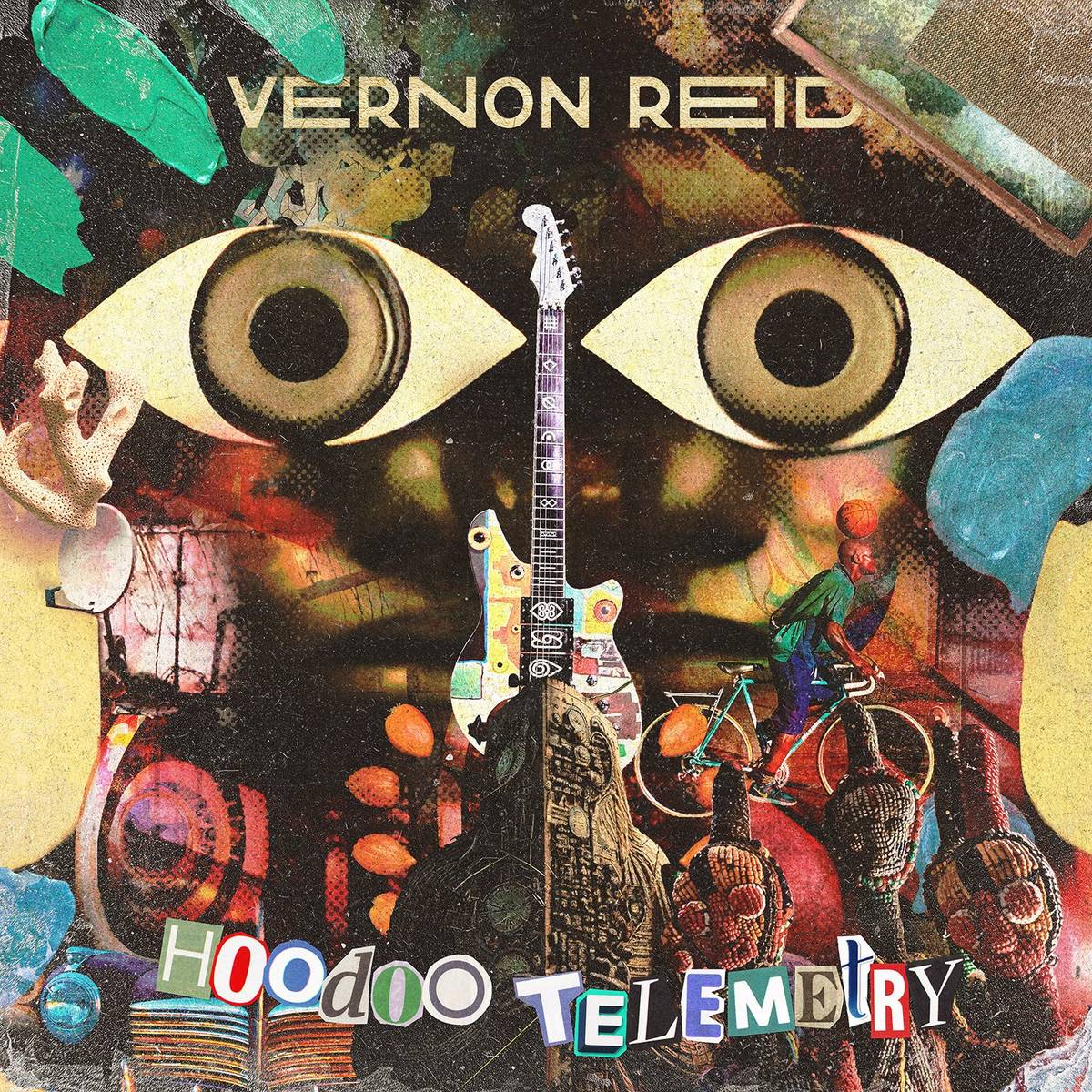
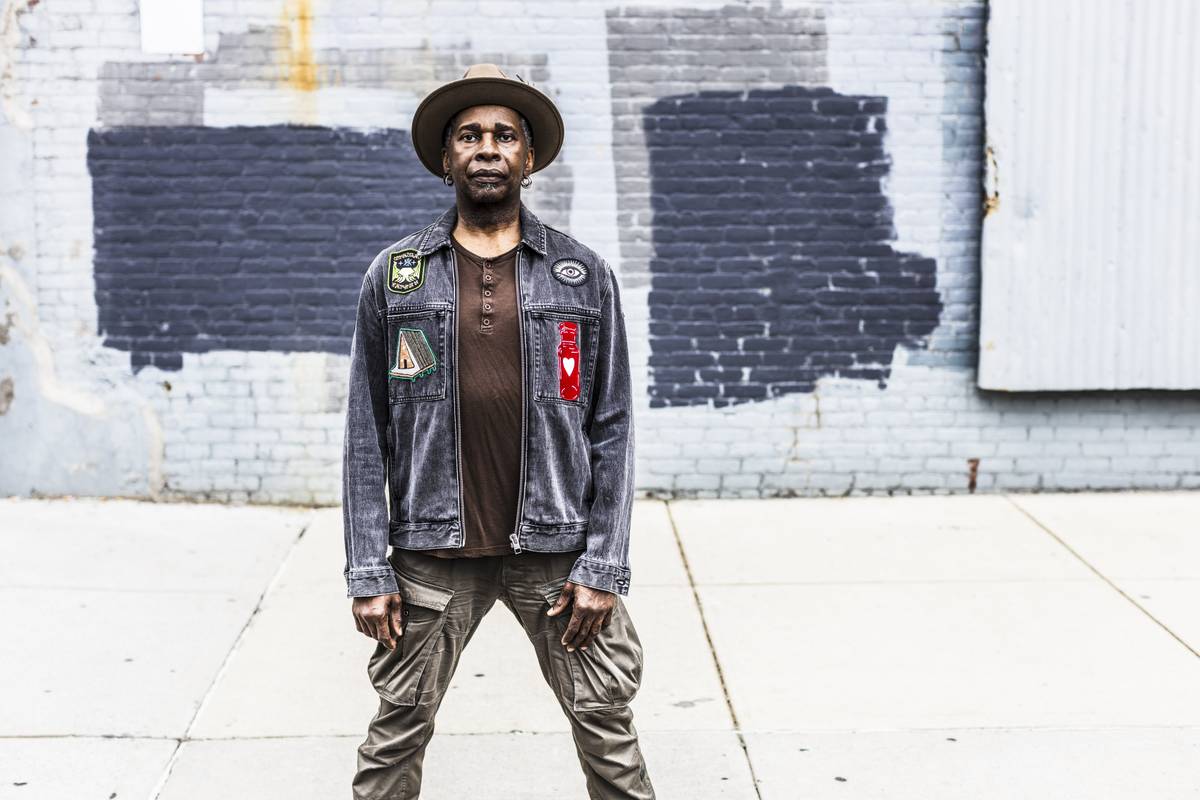
Hoodoo Telemetry, his first album released entirely under his own name since 1996’s Mistaken Identity, embodies this philosophy. The title itself speaks to the collection’s nature: “hoodoo” suggests mystical forces and folk magic, while “telemetry” implies the gathering of information from distant sources. “I can understand why anyone listening to it would go, ‘This is all over the place,’” Reid acknowledges. “But I’ve kind of been all over the place, really, in every context I’ve been in.”
The path to Hoodoo Telemetry began years ago, pre-Covid, but that “huge interruption” fundamentally shaped the record’s final form. During those lockdown days, Reid found himself cycling over New York bridges, taking photographs, playing guitar, and contemplating where he wanted his music to go.
The loss proved pivotal. Tate had written the first serious article about Reid and his music, and the two had been co-founders of the Black Rock Coalition. Tate passed on December 7, 2021 — the exact same date, Reid says, that the Black Rock Coalition held its first public event, in 1985. “It was a traumatic thing, and it sort of reframed or focused what I was doing — I wanted to make a record that Greg would like.”
Indeed, Tate’s influence permeates the album. Burnt Sugar, Tate’s experimental collective, is featured on three tracks, while Reid also says his friend encouraged him to sing more (which he does, on the track “In Effigy”). “[Greg] said, ‘Man, you have a quality to your voice,’” Reid says. “‘You have a thing,’ you know?”
There are other elements woven throughout Hoodoo Telemetry. “Part of the thread in the album is the idea of the diaspora — the idea of being adrift,” Reid says. This is reflected from the first track, “Door of No Return,” which draws on the historical term for the final passage of enslaved Africans leaving their homeland for America, to the closing number, “Brave New World,” which takes its title from Aldous Huxley’s cautionary dystopian novel. “Where’s the center, right?” he continues. “Especially when you realize the trip is a one-way trip.”
Musically, the album has an eclectic and adventurous spirit. There’s “Politician,” Reid’s take on the Cream classic. The choice reflects both personal history (Reid played the song with Jack Bruce in the band Spectrum Road) and contemporary relevance. “It’s my favorite Cream tune,” he says. The sentiment behind it, meanwhile, is “an evergreen thing,” he continues, “what with these jive so-and-sos….” >>>
“The Fool and Me”
Robin Trower.
1974 — Bridge of Sighs
((( >>> )))

Julien’s Auction House (Eric Clapton’s “The Fool” guitar)
Eric Clapton’s 1964 Gibson SG (“The Fool”) sold for a record-breaking $1.27 million at a Julien’s Auctions event, November 2020. The iconic instrument was purchased by collector Jim Irsay, owner of the Indianapolis Colts. A portion (?) of the proceeds from the sale went to the “Kicking the Stigma” mental health awareness initiative.
>>> Reid says he can understand why anyone listening to Hoodoo Telemetry might feel it’s all over the place stylistically. “But I’ve kind of been all over the place in every context I’ve been in,” he says.
“Ever since I saw Clapton with “The Fool,” I’ve loved guitars with graphics.”
Another song, “Freedom Jazz Dance,” emerged organically during recording sessions at Super Giraffe Sound in Brooklyn. Originally planned as an instrumental, the tune transformed when Burnt Sugar vocalist Bruce Mack suggested incorporating Eddie Jefferson’s vocal version. The result became what Reid describes as “this kind of ‘60s sci-fi version of the song.”
Perhaps most poignant is the skittering, atmospheric “Good Afternoon Everyone,” built around a found vocal recording Reid captured in the subway, where a homeless man repeated the same request with unchanging inflection: “Good afternoon, everyone. Can anybody help me with something to eat today?” What initially seemed like mere politeness revealed itself as controlled anger. “I realized, okay, he’s enraged. He’s not just being polite,” Reid says. “But his affect didn’t change. It was really chilling and really poetic.”
While Reid’s conceptual concerns drive much of Hoodoo Telemetry, his guitar work, the element that, of course, first brought him to prominence, remains equally compelling throughout, expertly balancing furious blasts of technical prowess with emotional expression. Reid can shred with the best of them, but he’s equally capable of restraint when the music demands it.
The contrast between tracks like “Door of No Return” and “Brave New World” illustrates this philosophy. The former demands intensity: “‘Door of No Return’ is really about a kind of feeling,” Reid says. “It’s a certain energy. It’s about loss, it’s about rage. It’s about figuring out, where do I go from here? You’re not going back home. And that requires a certain kind of approach.” Meanwhile, “Brave New World” prioritizes melodic content over flash. “That little guitar melody in the song is more important to me than the solo,” Reid says.
“If you think something is impossible, there’s no way forward.”
“MEDITATION ON THE LAST TIME I SAW ARTHUR RHAMES” serves as perhaps the album’s most personal statement (as well as a vessel for some of Reid’s wildest, most thrilling lead playing), honoring the avant-garde New York City-based musician who profoundly influenced Reid’s understanding of guitar possibilities.
“Arthur Rhames used to play stuff at Prospect Park [in Brooklyn], and it was only when I heard Allan Holdsworth that I said, ‘Oh, that reminds me of what this guy in Brooklyn used to do.”
The track combines blues elements with modal, Coltrane-influenced improvisation, “and there’s also influence from Sonny Sharrock and Pete Cosey, especially when he was playing with Miles [Davis], doing that super psychedelic, heavy, mysterious thing,” Reid says.
“One of the things I love about Miles in that period is he wasn’t trying to explain. He was like, ‘You either got it or you ain’t get it.'”
When it comes to the actual guitars on the record, Reid points out that the recording of Hoodoo Telemetry mostly predates the arrival of his current signature Reverend model, drawing instead from his extensive collection of instruments accumulated over the years. “Some of the stuff is my old Hamers,” he notes, referencing his custom Chaparral and the model he calls “Yin-Yang,” which appeared on multiple tracks. He also utilized his signature PRS S2 VR Vela, a Gibson ES-345, and a Stephen McSwain guitar with an aluminum flag top design that he nicknamed “Tuskegee.”
“That said, his Reverend signature model does make appearances, notably on tracks like “In Effigy” and “Brave New World,” which were recorded more recently. The Reverend features his preferred V-shaped neck profile, a specification he’s maintained since his ESP days, as well as a trio of custom Railhammer humbuckers that he says are “pretty amazing for the way they take to overdrive and distortion.”
Like Hammett and White, Reid is an iconic figure in the rock-guitar world. But if his success with Living Colour seems almost paradoxical given his deep roots (and experience) in jazz, experimental, and avant-garde music, he sees it as part of a natural continuum shaped by early exposure to diverse music.
“My folks, they never told me what music I should or shouldn’t listen to,” he says. “The only thing they said to me was, ‘Turn it down—it’s too loud!’ But they never said, ‘Don’t listen to that.’ I was never policed.”
Growing up in New York City also helped. Reid recalls going to “Music Row” (the stretch of 48th St.) in Manhattan that for decades was home to famed gear outposts like Manny’s and Sam Ash, and rubbing elbows with the likes of Leon Russell, Mark Knopfler, and George Benson.
“You would just see these guys walking around, and that made impossible things seem not completely unattainable,” he says.
New York was instrumental to Living Colour’s development as well. “Living Colour happened because of CBGB,” he says. “Without CBGB, we wouldn’t have built our local following. And that also goes for the Ritz, the Cat Club, the Mudd Club, all those places. Living Colour wouldn’t have happened without me playing with Ronald Shannon Jackson and the Decoding Society,” he says of his time with the downtown, avant-jazz collective. “And the reason why it wouldn’t have happened is because, from that, I learned it’s possible. That’s it. That’s the whole point. Because if you think something is impossible, there’s no way forward. I mean, nobody should play the lottery, right? Nobody should play Powerball. Logically, it’s a fool’s errand. Except for the fact that people win, right?”
That notion of possibility against the odds is what drives Reid’s continuing musical evolution. Even as he unleashes Hoodoo Telemetry, he’s assembling “a small but mighty ensemble” featuring longtime collaborators Leon Gruenbaum on keyboards and Steve Jenkins on bass for upcoming shows, including a performance at the Blue Note in New York City. And then there’s a new Living Colour record on the horizon, which, Reid says, “We’ve been in the process of writing,” as well as the possibility of performing music from his solo albums, stretching from Hoodoo Telemetry all the way back to Mistaken Identity. “It would be really fun to do that with the band,” he says. “And I’m excited about all of it. I’ve just gotta thread the needle, and away we go.”


