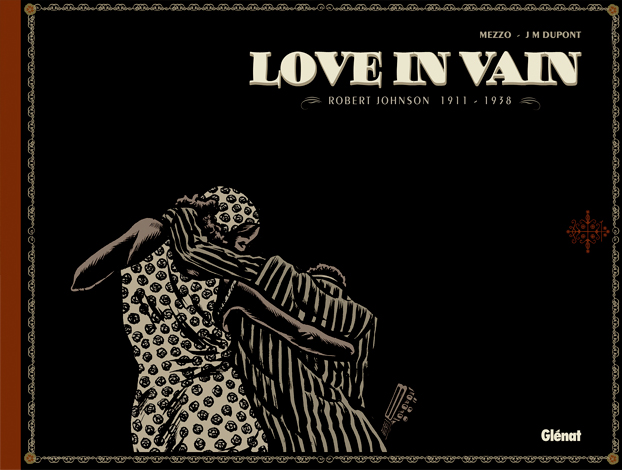
Love in Vain Robert Johnson (1911-1938) Jean-Michel Dupont & Mezzo’s 72-page graphic novel depicts the short life and hard times of Robert Johnson, the legendary, original Bluesman who made an infamous “Deal With The Devil,” on the sacred ground called the “Crossroads.”
In the Dark of a Moonless Night… is how the story of the Devil making his deal with Robert Johnson begins. On Sacred Ground, The Crossroads, where Johnson was first, but where many musicians after, sold their souls to the Devil, including Led Zeppelin,* as told by Stephen Davis in Hammer of the Gods.
In the delta of the Mississippi River, where Robert Johnson was born, it was said if an aspiring bluesman, in the dark of a moonless night, waited at the crossing of two deserted country roads, Satan himself might come and offer to tune his guitar. If accepted, the deal was that the bluesman was selling his soul to The Devil, who in turn, guaranteed the musician a lifetime of easy money, easy women, and legendary fame. They say Robert Johnson was the original Bluesman who let The Devil tune his guitar.
After taking a knee at the Crossroads, Johnson’s playing attracted attention and praise all around Mississippi, New Orleans, and Texas, where he did the first, of only two, recording sessions in his short life.
Just before his death, Johnson traveled to New York City, where he hoped to find the promised fame and fortune he always imagined.
Johnson was an American nomad, traveling throughout the South, and later, as far north as Chicago and New York City. He was a “walking bluesman,” by train, hitchhiking, even on the back of an available farm tractor.
He made it to New York City in 1937, and did a recording session for Columbia Records. It was the second and last recording Johnson ever did. Columbia abandoned the project, but the producer, John Hammond was impressed with Johnson, and asked him to play in a show he was working on. “From Spirituals to Swing” was scheduled to open in New York, December 1938.
Unfortunately, by the time the invitation reached Mississippi, Johnson’s road had ended. His Deal With The Devil was over. That summer, after drinking a glass of whiskey said to have been laced with strychnine by a man who’s wife Johnson had (met) earlier, Johnson died. He was 27 years old.
August 16, 1938, near Greenwood, Mississippi …
Johnson’s short journey ended where it had begun. THE CROSSROADS, THE MISSISSIPPI RIVER DELTA, SACRED GROUND.
French author Jean-Michel Dupont, in his GRAPHIC telling of Johnson’s story, takes you into Deep South America, when it was darkest.
The Blues was born of the Depression, after Prohibition and the Roaring ’20s, in a time of poverty, racism, and despair.
Johnson’s rise was fast and most dramatic when he left the South and headed for more “fertile” ground in “Down Home” Chicago and to the neon lights and ghetto streets of New York City.
On the road, out of the swamp, in run-down, but still wildly energetic bars, clubs, and joints along the Mississippi.
Johnson’s life was lived on The Devil’s Road, and he followed it wherever it took him.
Where There’s A Will, There’s The Devil. BAPTIST TOWN, MISSISSIPPI — A mural of legendary blues musician Robert Johnson, with lyrics from his song “Crossroad Blues.” The Green Book (1962) Boardwalk Empire (1920)
CLUB 27(TIME TO DIE) A posthumous compilation of Blues pioneers, including Robert Johnson, Son House, Big Bill Broonzy, Blind Lemon Jefferson, Charley Patton, Muddy Waters, Elmore James, Alexis Korner, Peter Green, and more.
Duke Ellington (Rhapsody In Blue) Cab Calloway Louis Armstrong Miles Davis Thelonious Monk Ella Fitzgerald Billie Holiday Robert Johnson Fats Waller Big Mama Thornton Louis Jordan Sammy Davis Jr. Tap (film) Gregory Hines Jackie Wilson Chuck Berry Little Richard Fats Domino James Brown Aretha Franklin Nina Simone Gil-Scott Heron MOTOWN STAX Otis Redding Issac Hayes Isley Brothers Sly & The Family Stone Marvin Gaye War Rufus Labelle Earth Wind & Fire Funkadelic
Living Colour Lenny White
Tony Williams Miles Davis
Herb Alpert Louis Armstrong
Love in Vain Robert Johnson (1911-1938) by Jean-Michel Dupont & Mezzo A black-and-white, 72-page hardcover book. €19.50
This review was based on the Dutch edition, published by Sherpa, who have a very nice preview on their homepage (in Dutch).
Dupont’s tight scripting coupled with Mezzo’s visceral visuals give rise to a powerful graphic novel. Let’s hope Fantagraphics is reading this so English-language readers can enjoy this one too!
Dupont writes not only about Johnson, but about the state of America in the thirties and how, for Johnson, music was the only thing that kept him going (coupled with the booze and women that life entails).
One clever choice to recount the events that shape Johnson’s life is Dupont’s decision to have everything recited by a mysterious narrator who is linked to rumours of Johnson’s fabled deal with the devil at the crossroads (which took me back to Tom Coker’s incredible The Ride: The Devil Don’t Sing No Blues, inspired by Johnson’s legendary bargain; check out this image for some art). As inspired as Johnson’s story and Dupont’s script are, the visuals by Mezzo (of hardboiled noir drama King of the Flies fame) are equally strong.
Mezzo’s solid black style, with heavy line work and strong staging, ups the ante on his previous work, and he turns in the best art I’ve seen from him yet. The landscape format allows him to go all out with rowdy crowd scenes, poverty-stricken rural areas and menacing skies of apocalyptic blackness. His figure work is also livelier and more fluid, showing an effort and a love of the subject.
Hailed as album of the year by French comic shops in 2015, Love in Vain. Robert Johnson – 1911-1938 by Jean-Michel Dupont and Mezzo is a dazzling read about a life dominated by the power of music and its ability to deliver hope in despair, and the dichotomy of a life searching for comfort as an escape.
Robert Johnson: The Legend The Devil The Crossroads Club 27
In 1936, Robert Johnson’s most important of his (only) two recording sessions was in San Antonio, Texas at the Gunter Hotel. The session took place in room 414, which Brunswick Records had converted into a temporary recording studio.
Story of the bluesman, the Devil, and the deal at the crossroads, as retold in Stephen Davis’s Hammer of the Gods.
In the delta of the Mississippi River, where Robert Johnson was born, they said that if an aspiring bluesman waited by the side of a deserted country crossroads in the dark of a moonless night, then Satan himself might come and tune his guitar, sealing a pact for the bluesman’s soul and guaranteeing a lifetime of easy money, women, and fame. They said that Robert Johnson must have waited by the crossroads and gotten his guitar fine-tuned.
Highway 61 & Highway 49 (aka the Crossroads)
I went down to the crossroads and fell down on my knees, asked the Lord up above for mercy, save poor Bob if you please.”
— “Cross Road Blues”
You may bury my body down by the highway side so my old evil spirit can get a Greyhound bus and ride.”
— “Me And The Devil Blues”
If you want to learn to play anything you want to play and learn how to make songs yourself, you take your guitar and you go to where a crossroads is. A big black man will walk up there at the stroke of midnight and take your guitar, and he’ll tune it…”
— LeDell Johnson
Robert Johnson’s life is a blend of folklore and mystery. His life is engulfed in myth and legend; adding the myth is his haunting lyrics. And his impressive, innovative country guitar style; you can quickly see why he is known by many as the father of the Delta Bues. Robert Johnson’s guitar playing was the beginning of the his legend. Robert was heavily influenced originally by Son House and Charley Patton, but Johnson quickly found his own style with unique chord movements and note progressions. Robert traveled throughout the Deep South in the 1930’s playing anywhere the train happened to take him. Son House had known Robert when he began to learn to play. House went on the road and did not see Robert for three or four years, and when Son and Johnson finally did meet again, House was astounded by Robert’s impressive guitar playing….but….
Just how did Robert learn to play so well so fast?
Robert Johnson was a Mississippi blues singer and songwriter, who according to legend, sold his soul to Satan “at the crossroads” in exchange for his remarkable talent on the guitar.
Born and raised in Mississippi, Robert Johnson started playing blues guitar in the late 1920s. His wife and child died in childbirth around 1930 and he is said to have devoted himself to the guitar. Part of the crossroads story comes from a report that he dropped out of sight for a while in the early 1930s and returned a much-improved guitarist.
In 1936-37 he recorded at least 29 songs in Texas (San Antonio and Dallas), then returned to Mississippi to play and sing in clubs and bars. His mysterious death at the age of 27 added to the legend: He died in 1938, falling ill after playing a party and dying four days later.
Some people said that Robert’s deal with the devil came due and as evidence gave the fact that they had seen him on all fours, howling at the moon the night he died.
…Or that he was shot by a jealous husband ( Robert was not shy with the ladies, and often stayed in strange towns with women he found at the places he played at. ). Or stabbed by a woman.
The truth is that Robert was poisoned, either by the barkeeper at the saloon he played that night, who was angry because Robert had been talking to his wife, or by a jealous girlfriend.
Whatever the reason, Johnson died at the young age of twenty-seven, and left a legacy of Delta Blues music that has influenced guitar players like Muddy Waters, and his songs have been covered by several rock stars, including Eric Clapton and The Rolling Stones.
In 1986 he was inducted into the Rock and Roll Hall of Fame. His songs include “Crossroad Blues,” “Me and the Devil Blues” and “Terraplane Blues.”
Adding To Robert’s Mystic and Folklore…
Those who saw Robert Johnson play, may have also heard the rumors. Just like anyone who possesses an extraordinary talent and skill… Jealous counterparts circulated vicious rumors about Johnson.
In fact, it was Robert’s one time friend and mentor, the great Son House who stated “He sold his soul to play like that”. Johnson’s peculiarities added to the rumors.
Some fans thought that he had the “evil eye.” Actually, he suffered from a small cataract. Also, it has been reported that Johnson would turn his back to the audience while playing. Robert would also leave suddenly from a performance, and sometimes even during breaks in his set. While today such actions are not considered odd, In those days they were. Many people took it to mean that he was a man with something to hide. Actually, Johnson was doing some things that many musicians still do today. It’s not uncommon to leave right after a performance in order to avoid mob scenes and the company that maybe around after a show. Eddie Van Halen, for example, also would turn from the crowd during club shows; to hide his technique from other guitarists.
Johnson’s choice of teacher did nothing to slow the Legend from spreading His instructor, Ike Zinnerman, was alleged to have learned to play the guitar at night sitting atop tombstones in old country churchyards.
In certain southern communities, it was a well-known notion that one could go to the crossroads and sell one’s soul to the devil. The concept dates back to African Folklore. When deity Esu was believed to be the guardian of the crossroads, and was the laision between the gods and humans.
When Christianity was brought to African Culture, these pagan gods were labeled as being similar to the devil. Hence, the concept that one could find the devil at a crossroad.
“Old 8”: The True Crossroads
Highway 61 runs south, right through the middle of the delta. It intersects Highway 49 at Clarksdale, Mississippi.
Clarksdale is the birth place pf many blues legends. It was the home to such people Muddy Waters, W.C. Handy, Junior Parker and John Lee Hooker, just to name a few.
Over the years, Clarksdale has become known as the home of the blues, so it was just assumed that this is where The Crossroads were. In later years, ”61/49 Clarksdale” has been so heavily advertised as The Crossroads.
But, in Memphis a couple of different sources, claim that 61 and 49 are not The Crossroads. The legend supposedly began around the turn of the century from the originators of the blues … at Dockery Farms. The location given by a couple of sources is ”WHERE DOCKERY ROAD CROSSES OLD HIGHWAY 8” This would be between Cleveland and Ruleville.
The Crossroads…could you just stand there…at the Crossroads on a dark moonless night?
Rumor Has It…
That Eric Clapton was the first to use the term, “the 27 Club.” He himself has claimed to have narrowly escaped the spector of death at the age of 27 due mainly to heroin addiction. But many famous musicians have fallen prey to the imfamous club that was founded by Robert Johnson.
Others from whom The Devil Collected His Due, All at 27: Brian Jones Jimi Hendrix Janis Joplin Jim Morrison Kurt Cobain Brad Nowell Jesse Belvin Malcolm Hale Alan “Blind Owl” Wilson Linda Jones Ron “Pigpen” McKernan Dave Alexander Pete Ham Gary Thain Helmut Köllen Chris Bell D. Boon Jean-Michel Basquiat (yes, he had a band, Gray) Pete de Freitas Mia Zapata Kristen Pfaff Richey Edwards (disappeared and presumed dead) Fat Pat Freaky Tah Sean Patrick McCabe Jeremy Michael Ward Bryan Ottoson Valentín Elizalde Levi Kereama Amy Winehouse
Ocala blues musician Rev. Billy C. Wirtz explores the Florida clubs and artists that defined Black music during the days of Jim Crow.
Muddy Waters stepped up to the mic and spit out the words, “You can’t lose what you ain’t never had.” Otis Spann hit a C major trill on the piano and somewhere deep inside me, a switch was thrown.
It wasn’t just the music but the look as well. Muddy looked like a ruler from some incredibly cool universe. His sky-high hair, styled in the chemically processed “conk” of the time, glimmered in the late-afternoon sunlight. He wore a purple sharkskin suit, wraparound shades and black patent-leather alligator-grain Beatle boots.
The year was 1968. I was a 14-year-old, middle-class white kid attending the Smithsonian Folklife Festival in Washington, D.C. Up until then, I had wanted to be a park ranger. But after I saw and heard Muddy, that ambition veered from the trail and fell off a rocky ledge.
I wanted to be part of a world where people made music like that, and where grown men with names like “Muddy” wore patent-leather, razor-toed, Cuban-heeled footwear to work.
I bought every book on blues and soul music that I could find, spent all my money on albums, worked in record stores and went to the few concerts I could get into. I bought a guitar, joined a band and have devoted the rest of my life to gospel, blues and roots music.
I’ve played it, written about it, programmed it on my own radio shows on the East Coast, the West Coast and places in between, slept on the couches of blues legends and stayed up after shows soaking up their stories until dawn. Some 50 years later, the switch remains fully in the “on” position.
I’ve traveled down a lot of back roads in music, but no trip has been as transformative as my journey through the history of the Chitlin’ Circuit, an assortment of nightclubs, dance halls, juke joints and theaters—mostly located across the Midwest and Southeast, with many in Florida—where many now legendary African American performers and their audiences could connect during segregation.
Although it’s thought that the term “Chitlin’ Circuit” was first used in 1972, in a Chicago Defender article about Ike and Tina Turner, the circuit had its heyday from the 1930s through the 1960s. (The name comes from a soul-food staple called chitterlings, or chitlins—pig intestines, boiled then fried.)
The Chitlin’ Circuit provided musicians of color with safe lodgings and food and on-the-job training for young players who showed promise. These venues were also the explosive incubator of some of the greatest blues and soul music ever played.